From Q&A and code generation to letting agents take on more complete pieces of work, I have now been using AI for several years.
Model capabilities are not the only thing that has changed. The ways we use them have gone through several rounds of change as well. My own approach has evolved with them: sometimes I chat with AI, sometimes I use AI embedded in an app for immediate assistance, and sometimes I hand an entire piece of work to an agent.
I have not found one best way to use AI. Chat is well suited to discussion and organizing information. AI embedded in an app is responsive and fluid. An agent extends a single exchange into a sequence of actions in which it can explore, use tools, and correct its own results. They serve different situations; none has truly replaced the others.
But as agents began taking on more complex work, I ran into a different question: an AI being capable of doing the work is not the same as my being willing to hand the work over.
This is Part 1 of a two-part series. This article explains why I no longer base my way of working on the next generation of models. Part 2 describes the kind of AI workflow I would actually trust with delegated work.
I No Longer Base My Workflow on the Next Model
Models will certainly continue to improve. I am not interested in predicting when capability gains will slow down, or when AGI will arrive.
I simply no longer assume that a stronger model will make today’s collaboration problems disappear on their own.
The same model can still produce different results on the same task. The more complex the task, the more those differences can grow. A new model may make fewer mistakes and use tools more effectively, but it does not automatically turn AI into a perfectly deterministic input-output system.
A common approach is to let one model perform the work and another check it. That can add a different perspective, but it does not guarantee convergence. The reviewer can also make mistakes, and may inherit assumptions the first model never made explicit.
So I need more than a higher capability ceiling. Capabilities can keep improving, but my way of working must already function while model behavior still varies.
Generality Is Also a Constraint
There is another, often overlooked constraint: generality. Model and tool vendors need to serve different users, industries, and ways of working. Their products therefore prioritize shared capabilities—understanding instructions, using tools, managing context, and completing general-purpose tasks.
This is not a failure on the vendors’ part; it follows from the role of a general-purpose product. There is no universal answer to why a piece of work is worth doing, where its boundaries lie, how strict its acceptance criteria should be, or which actions require separate authorization. The more general a product must be, the harder it is to optimize deeply for one professional workflow or make choices tailored to a particular user.
Vendors can provide better models, tools, and extension points, but they cannot complete the final layer of adaptation for me. So I am not waiting for an official tool to naturally grow into the workflow that fits me best, either.
Complex Work Will Eventually Span Multiple Contexts
As a context grows, goals, rules, and earlier decisions gradually lose weight. Even if the context window can hold more text, the model may not give every part equal attention.
Complex work therefore has to be split sooner or later: into a new conversation, handed to another agent, or continued by the same model in a fresh context.
Splitting introduces information loss, but it also has value. A fresh context does not have to inherit the previous line of thought and can make a new judgment. Separating roles is also more credible than having the same model perform the work and then declare that it has independently reviewed itself.
The difficult question is not whether to split the work, but what will carry it across the split.
If the goal, boundaries, and decisions exist only in the chat history, every new context needs the task explained again. The model may miss a premise, or treat a temporary judgment from the previous round as a final decision. The more contexts there are, the more easily drift accumulates.
Starting a Piece of Work Is Harder Than It Looks
Asking a question is easy. Having AI generate a feature is easy too. The hard part is turning something that exists in a person’s mind into a piece of work with clear boundaries, testable results, and a reliable handoff.
Spec-Driven offers one answer, but it usually assumes that a reasonably complete specification already exists. My day-to-day work rarely begins that way. At first I have only an intention. I need to discuss it with AI, then gradually clarify the goal, scope, non-goals, and definition of done.
This is exactly where starting the work becomes difficult. A model can organize the discussion and ask questions, but it cannot decide why the work is worth doing, how far it should go, or which actions have been authorized. Intent, value, and authorization are not facts the model can infer from context. They have to come from a person.
Rules Cannot Live Only in the Model’s Prompt
Newer models follow instructions and documents much better than older ones, but prescribed formats and steps can still loosen over the course of a long task.
Adding more prompting does not necessarily help. The more rules we write, the heavier the context becomes, and the more the model has to remember and interpret at the same time.
My conclusion is that any check an external tool can perform reliably should not depend on the model remembering to perform it every time. Models are good at judgment and execution. Tools are good at providing facts, preserving state, and enforcing boundaries that should not change with an in-the-moment interpretation.
The Question I Care About Has Changed
Taken together, these observations lead to a practical conclusion: delegation is not blocked by one isolated weakness in the model, but by several kinds of problem occurring at the same time.
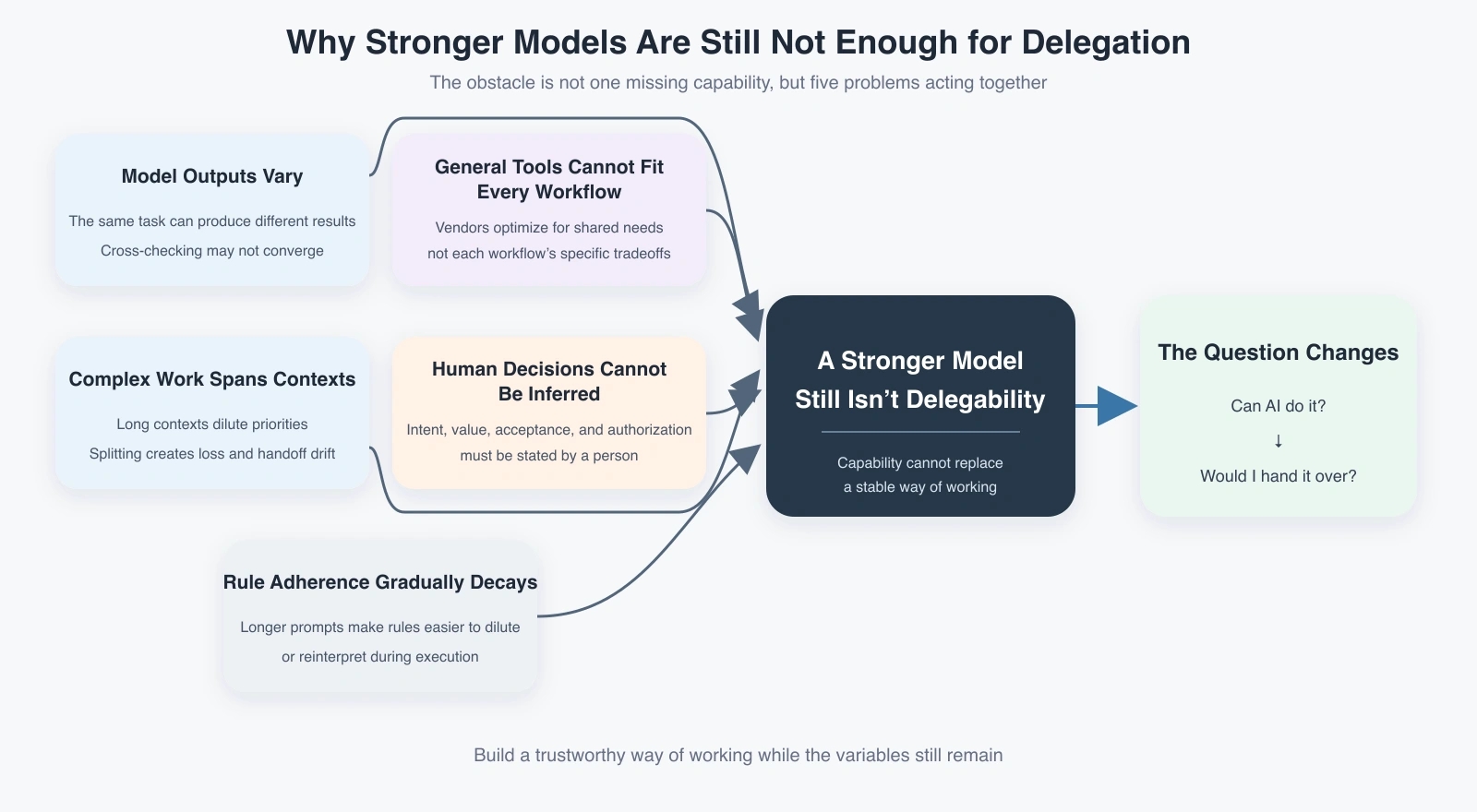
So I no longer ask only, “Can AI complete this work?” With the models I use today, AI can already do a great deal of it.
What matters more to me is: can I hand the work over without watching every step?
This is not about peak capability. It is about whether the scope remains stable, whether the result receives a trustworthy review, whether the cost is predictable, whether interrupted work can continue, and whether the system knows when a decision must return to a person.
I group these qualities under one term: “delegability.” Part 2 continues from there.